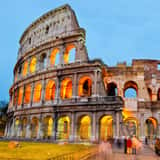
Why one side looks more complete
The surviving outer ring is much more intact on one side of the monument. Elsewhere the deeper structural rings are exposed, making it easier to read how the building was constructed.
The Colosseum has spent almost two thousand years changing purpose — from imperial amphitheatre to fortress, quarry, sacred monument and archaeological site. Understanding that history also makes today’s visit easier: the Arena, Underground, Attic and main levels are not interchangeable names, but different parts of the building with different access rules.
The Colosseum is easier to understand when you stop thinking of it as one unchanged ancient monument. Its structure reflects imperial politics, spectacle technology, earthquakes, medieval occupation, stone removal and centuries of restoration.
The new amphitheatre was built in the valley occupied by part of Nero’s Domus Aurea complex. Nero’s artificial lake had stood where the Colosseum now rises. The Flavian project turned this prominent part of the former imperial estate into a vast public entertainment building.
Titus formally opened the building with a long programme of spectacles. Ancient accounts associate the inauguration with one hundred days of events, including gladiatorial contests, hunts and elaborate public entertainment.
The underground service system was transformed into masonry during the reign of Domitian. Beneath the arena, corridors, hoists, platforms and lifts allowed people, animals and scenery to appear through openings in the arena floor. This is the area now sold as the Underground experience.
The amphitheatre was repeatedly repaired after fires and structural damage. Its underground machinery also changed several times. Gladiatorial games eventually ended, while other forms of spectacle continued before the building gradually lost its original function.
The abandoned monument did not simply sit empty. Medieval occupation included houses, workshops and fortified areas. The Frangipane family established a fortress within part of the amphitheatre, using its enormous surviving walls as part of Rome’s defensive landscape.
For centuries the Colosseum supplied reusable stone and other materials. Increasing religious association with Christian martyrdom gradually changed how the monument was treated, and in the eighteenth century papal action helped bring destructive quarrying to an end.
Today the Colosseum is managed together with the Roman Forum and Palatine within the Parco archeologico del Colosseo. Modern visitor routes expose different layers of the monument — from the arena and hypogeum to the main orders, museum spaces and upper levels.
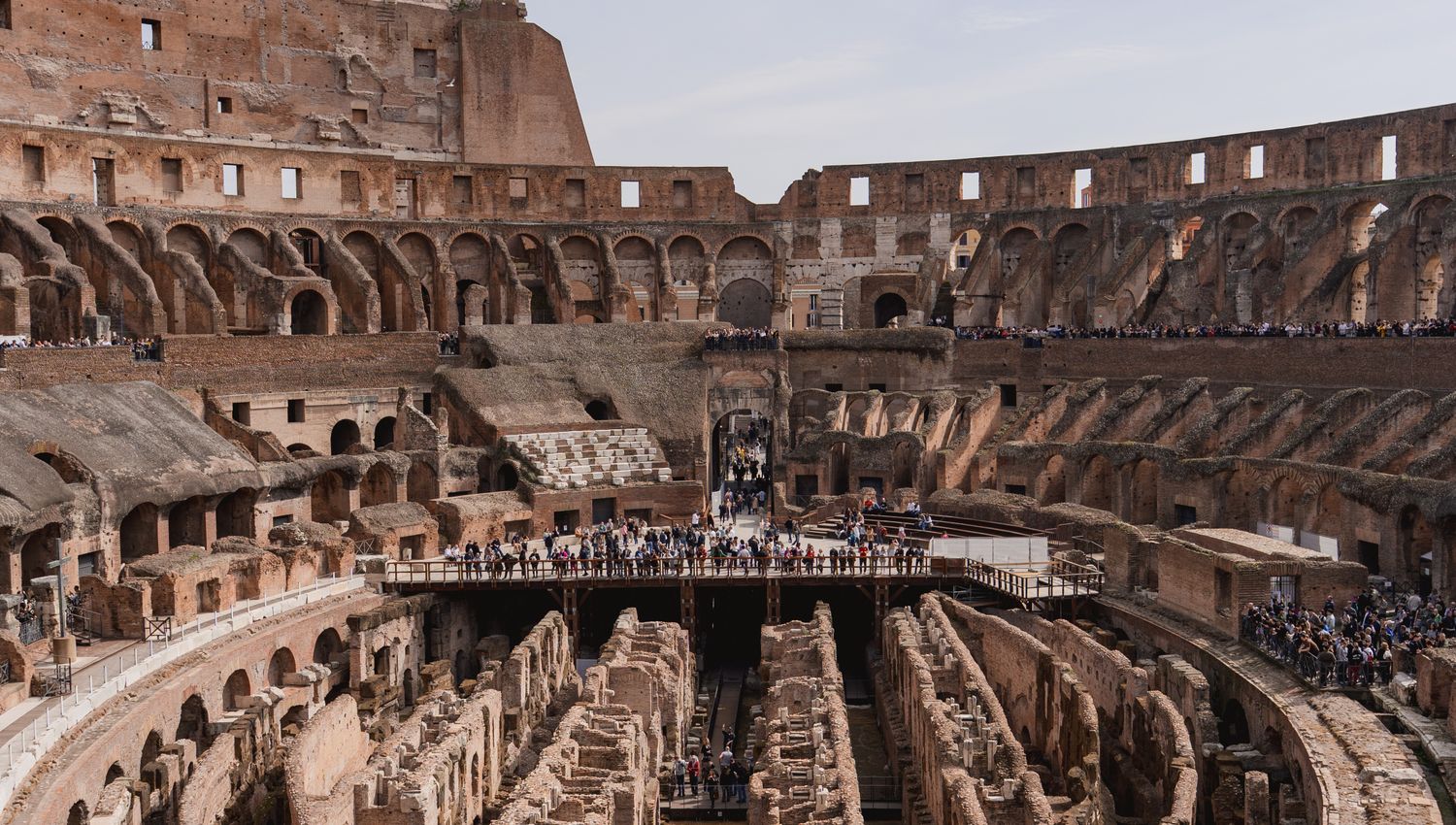
A lot of the Colosseum’s story is still readable in the structure itself. These are worth looking for rather than simply walking from viewpoint to viewpoint.
The surviving outer ring is much more intact on one side of the monument. Elsewhere the deeper structural rings are exposed, making it easier to read how the building was constructed.
The many holes visible in the stone are part of the monument’s later history. Metal fittings and clamps were removed as useful materials were taken from the building over the centuries.
The exposed underground corridors were hidden beneath the arena in antiquity. They contained the technical infrastructure needed to stage the spectacles.
The amphitheatre’s stairs, passages and seating levels were organised to move large numbers of spectators while keeping different social groups in designated parts of the building.
Today’s monument is much more stripped-back than its ancient appearance. Marble, painted surfaces, stucco and decorative materials once covered parts of the structure that now appear exposed.
Restoration, reinforcement and reconstructed elements are part of the Colosseum you visit today. They help stabilise the monument and make parts of its original form understandable.
The most important details are your booked Colosseum time, the name on the ticket, the access type you bought and what you bring with you. Check these before arriving rather than at the gate.
The Colosseum opens at 08:30. The Roman Forum–Palatine area opens at 09:00.
For 29 March–30 September 2026, the park closes at 19:15, with last admission at 18:15. From 1–24 October it closes at 18:30, and from 25 October the winter closing time becomes 16:30.
The park is closed on 25 December and 1 January.
Scheduled free admission includes the first Sunday of each month and the national free-entry dates of 25 April, 2 June and 4 November. Special-access areas may not operate on free days.
Keep an identification document available with your ticket when entering. The current rules allow a ticket-holder name to be changed only once, before the stated deadline, and only in specific permitted circumstances.
Do not book using a random name with the intention of fixing it at the gate.
Colosseum entry requires a reserved time slot, and official ticket sales normally open 30 days before the visit date.
Arrival rules depend on the ticket. Standard and some routes require visitors to report at least 15 minutes early; Underground visitors are instructed to arrive earlier. Treat the booked time as fixed.
Current visitor regulations limit hand luggage to 30 × 40 × 15 cm. Oversized backpacks, suitcases and trolleys should not be brought to the park.
The park has no cloakroom or luggage-storage service, and visitors undergo security screening before entry.
The official MyColosseum app is free on iOS and Android and includes interactive audio guides in English and Italian.
Its audio content follows visitor routes including the Underground, intermediate gallery and Attic.
On designated free days, capacity and conservation rules can restrict the Arena, Underground, upper levels and some SUPER sites. Check the official notice for your specific free-entry date before planning around those areas.
The useful distinction is not simply standard versus premium. Each ticket opens a different route, and several ticket names sound more similar than their actual inclusions.
The standard route includes one entry to the Colosseum’s first and second orders plus the wider Roman Forum–Palatine archaeological area.
Choose this route when standing at arena level is important to you. Arena access changes the viewpoint from looking down into the amphitheatre to looking up through its seating structure.
This route adds the hypogeum beneath the arena, where the technical preparations for spectacles took place. It also includes Arena access and the wider Full Experience park benefits.
This route focuses on the upper architecture and elevated views rather than the Underground. It includes the panoramic lift as part of the designated Attic visit.
This ticket gives a single access to the Arena section of the Colosseum, rather than the standard first-and-second-level route.
This is for the Roman Forum, Imperial Fora and Palatine area with relevant SUPER-site access.
Your reserved amphitheatre time is the least flexible part of the itinerary, so organise the wider archaeological park around it.
Full Experience validity lets you avoid forcing the Colosseum, Forum and Palatine into one exhausting continuous visit.
Third-party listings can use broad marketing titles. The access areas named in the actual ticket are what determine where you can enter.